
SECRET BEHIND THE FORMATION OF HIGH SPEED WINDS ON NEPTUNE
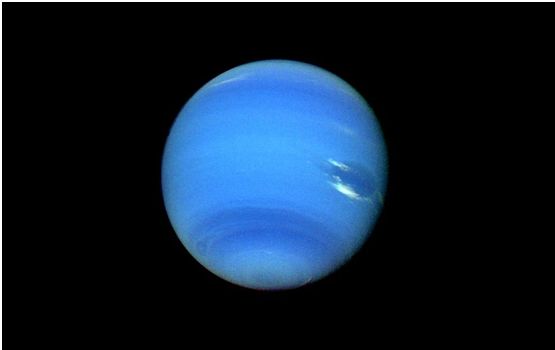
Neptune is the eighth planet in the solar system if we consider its distance from the Sun. Neptune is also the fourth largest and third heaviest planet in our solar system. It is seventeen times heavier than earth. Atmosphere of Neptune is very thick and most of it is composed of gas. Due to this reason, Neptune is considered as a gas giant. Neptune’s atmosphere mostly consists of hydrogen and helium gas and due to the presence of small amounts of methane, the planet appears blue in color.
Galileo illustrated the presence of Neptune near Jupiter in his drawings but he failed to categorize it as a planet. Neptune was the first planet to be discovered with the help of mathematical calculations instead of a telescope. The planet was first discovered by the astronomers Urbain Le Verrier and John Couch Adams in 1846. Neptune was named after the Roman God of Sea.
As of now, only one spacecraft has visited Neptune and it was NASA’s Voyager 2. The space craft did a quick flyby of the planet and its closest encounter happened on August 25, 1989. Neptune is the last planet to have been visited by a spacecraft. When Voyager flew by Neptune, strange weather events were observed. In 1989, Voyager 2 observed a very large cyclonic storm on Neptune which is known as the Great Dark Spot. But when Hubble telescope observed Neptune on November 2, 1994, there was no Great Dark Spot on the planet but instead, a new storm similar to the Great Dark Spot was found in northern hemisphere of the planet.
Very small, blue colored rings were also observed on the surface of Neptune. Neptune’s mass is about 10.243×10^25 kg and it is seventeen times heavier than earth and eight times lighter than Jupiter. Along with Uranus, Neptune is considered as an “ice giant” which a subclass of “gas giants”. Surface temperature of Neptune is about 55 Kelvin since it orbits far from the Sun.
The winds that blow on earth are controlled by the Sun’s energy. When a planet is closer to the Sun, faster winds are expected. Surprisingly, Neptune, which is the farthest planet from the Sun, has strongest wind speed in our solar system. Neptune’s internal energy is strong enough to create the fastest winds.
It was expected that at a planet which is far away from the Sun, will have lesser energy and there will not be any presence of strong winds around. Rather than seeing slower winds, the scientists found faster winds on Neptune which have speeds close to 1600 km/h or more. This is more than the top speed of a U.S. Navy F/A-18 Hornet fighter jet! 250 miles per hour (400 kilometers per hour) is the most powerful winds on Earth’s surface.

The formation of high speed winds on Neptune was an open question for more than 25 years. Two theories were proposed to explain these phenomena. Either the winds were created as a result of the surface phenomena, restricted to the upper atmosphere, or they were created by some deeper planetary dynamics that could be closer to core of the planet. With the help of data collected by Voyager 2 in 1980s, the researchers determined that the first explanation was correct. They calculated that the winds were so shallow that they were present on the outermost 0.2 percent of Neptune’s surface which is about 1,100 km. There is also one other theory which says that Neptune generates more energy than it receives from the sun, and this energy, radiating from the planet’s core is what drives the strong surface winds. On Neptune, a blanket of methane is present which a greenhouse gas and that help to traps heat. Neptune radiates 2.7 times more heat than it receives from the sun, which is enough to drive its high speed winds.
Both these theories exist in order to explain the presence of high speed winds on Neptune. Let’s hope that the future studies will give us a better picture to explain this phenomenon.
GyanPro Blog
GyanPro Blogs
ice giant
NASA
NASA's Voyager 2
Neptune
Science
ScienceArticle
Solar System
SolarSystem


